
NPO Meaning in Business: The Canadian Guide

NPO stands for non-profit organization: a legal entity created to pursue a mission rather than to generate profit for its owners. If you arrived here from a medical chart, NPO there means something entirely different, nil per os, or nothing by mouth. This guide covers the business and legal meaning in Canada.
What does NPO mean in business?
In business and law, an NPO is a corporation without share capital, formed to carry out a stated purpose without distributing gains to its members. It has members instead of shareholders, issues no shares and pays no dividends. It can still earn revenue, employ staff and hold assets.
The acronym shows up in three slightly different forms depending on who is writing, which is why it looks inconsistent across government websites:
| Source | Term used |
|---|---|
| Corporations Canada | Not-for-profit corporation (NFP) |
| Canada Revenue Agency | Non-profit organization (NPO) |
| Registraire des entreprises du Québec | Personne morale sans but lucratif |
| Quebec common usage | OBNL or OSBL |
| Everyday usage | Non-profit, not-for-profit, NPO |
None of these carry a different legal meaning. What actually matters is the statute the organization was incorporated under, not the label.
What is an NPO status?
There is no single "NPO status" you apply for. In Canada, being a non-profit is the result of two separate things that people constantly merge into one:
- A corporate status, obtained by incorporating under a federal or provincial statute. This creates the legal entity.
- A tax status, granted automatically under paragraph 149(1)(l) of the Income Tax Act when the organization is organized and operated exclusively for social welfare, civic improvement, pleasure, recreation or any other purpose except profit.
You do not register with the CRA to become an NPO. The exemption applies by operation of law as long as you meet the conditions. That is the single biggest difference between an NPO and a registered charity, which does require an application and an approval.
Can an NPO make a profit?
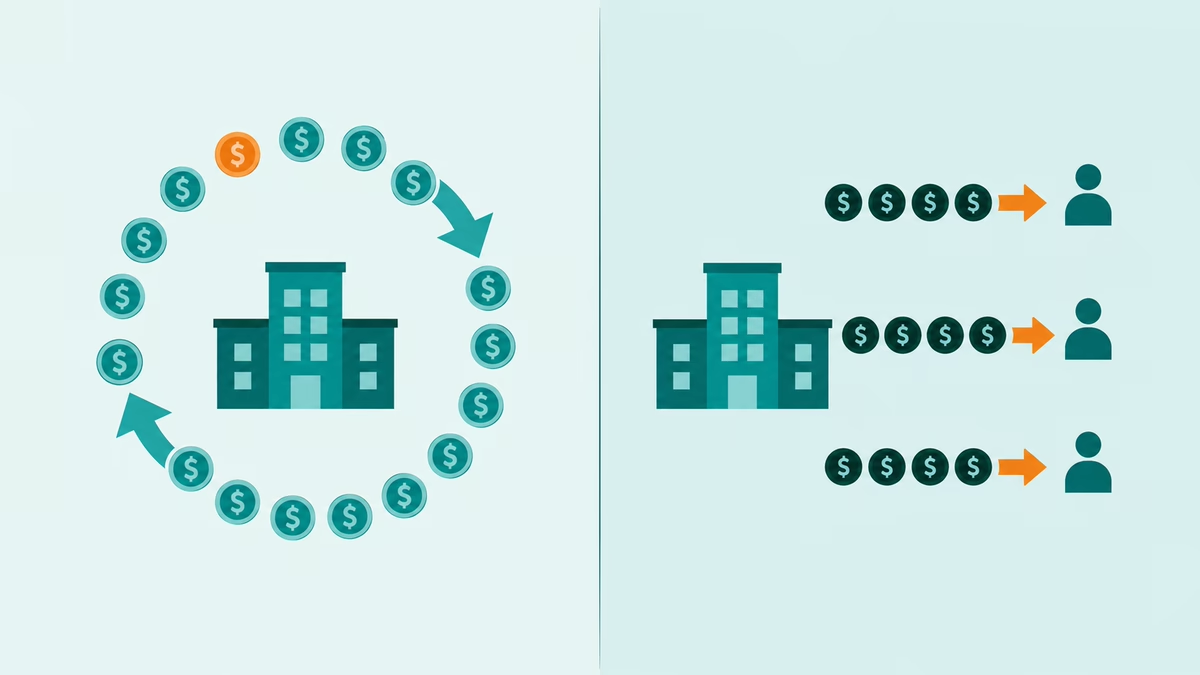
Yes. An NPO can sell goods and services, invoice contracts and finish the year with a surplus. What it cannot do is distribute that surplus to its members.
An NPO can:
- charge for tickets, training, memberships, subscriptions or products;
- contract with private businesses;
- build a reserve to fund a future project;
- pay reasonable salaries to employees, including members who work for it.
An NPO cannot:
- pay dividends or patronage returns to members;
- distribute surplus other than in support of its purpose;
- allow income to be payable to, or otherwise available for the personal benefit of, a member or director.
That last point is broader than most founders expect. Paragraph 149(1)(l) does not only prohibit formal distributions: the exemption is lost if any part of the income is payable to or available for the personal benefit of an owner, member or shareholder. An indirect benefit is enough to put the status at risk.
Members instead of shareholders: how an NPO is governed
An NPO has no share capital, so there is nothing to own and nothing to sell. Control flows through membership rather than equity.
| Feature | Business corporation | NPO |
|---|---|---|
| Holders | Shareholders | Members |
| What they hold | Shares | Membership, normally not transferable |
| Financial return | Dividends, capital gain | None |
| Who votes | Shareholders' meeting | Members' meeting |
| Who manages | Board of directors | Board of directors |
| Minimum directors | 1 | 1 federally, 3 in Quebec |
| Exit | Sell the shares | Resign or lose membership |
The governance cycle is circular and worth stating plainly: members elect the directors, the directors admit new members according to the articles and by-laws, and the directors appoint the officers. Under the federal statute, directors cannot be appointed by virtue of holding another position. Membership rules therefore decide who ultimately controls the organization, which makes the by-laws the most consequential document an NPO ever drafts.
NPO vs registered charity: the difference that costs the most
Incorporating an NPO does not make it a charity and does not allow it to issue official donation receipts. This is the most expensive misunderstanding in the sector.
The two statuses are mutually exclusive under the Income Tax Act. An NPO cannot be a charity, and a charity, whether registered or not, cannot be an NPO. The exemptions come from different provisions: paragraph 149(1)(l) for an NPO, paragraph 149(1)(f) for a registered charity.
| Question | NPO | Registered charity |
|---|---|---|
| Application required | No | Yes, to the CRA |
| Issues donation receipts | No | Yes |
| Purposes | Any non-profit purpose | Exclusively charitable purposes |
| Annual information return | T1044 if thresholds are met | T3010, mandatory |
| Corporate income tax return | T2 | T2 generally not required |
To register as a charity, every stated purpose must fall within one of four recognized heads: relief of poverty, advancement of education, advancement of religion, or another purpose beneficial to the community in a way the law regards as charitable. The CRA's service standard targets a final decision within nine months of receiving a complete application.
Practical advice: check the charitable requirements before drafting your purposes. Changing them afterwards requires amending the incorporating document, which means additional fees and delay. Our guide on the differences between an NPO and a charity walks through the comparison.
Federal or Quebec: where to incorporate an NPO
Both regimes work, and a federal NPO can operate in Quebec. The decision usually comes down to the number of directors you can realistically recruit and where you plan to operate.
| Criterion | Quebec, Part III | Federal, NFP Act |
|---|---|---|
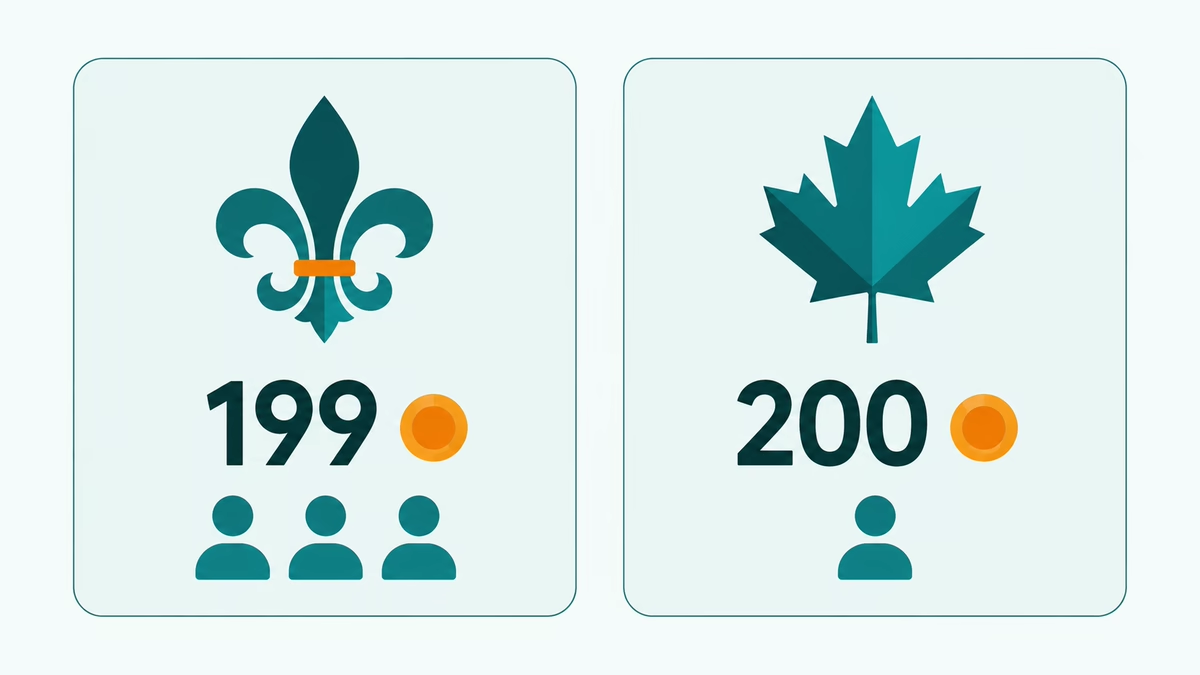
| Incorporation cost | about $199 | about $200 online |
| Processing time | not published | 1 business day |
| Minimum directors | 3 | 1, or 3 if soliciting |
| Director residency | none required | none required |
| Incorporating document | letters patent | articles of incorporation |
| Annual filing | about $41 | about $12 plus Quebec registration |
| Name search | optional reservation, about $27 | included in the online application |
Approximate fees in effect in 2026. Confirm on the official Quebec fee schedule and with Corporations Canada.
Two things are worth knowing before you choose.
First, a Quebec NPO costs about $199 to incorporate, not $397. The $397 figure circulating online is the certificate of incorporation fee for a business corporation and does not apply to non-profits.
Second, the federal soliciting corporation rules quietly change the requirements. An organization that receives more than $10,000 in a financial year from public donations, from federal, provincial or municipal government grants, or from another soliciting entity becomes a soliciting corporation. It must then have at least three directors, at least two of whom are neither officers nor employees. Founders usually watch the donation threshold and miss the grant one.
A federal NPO carrying on activities in Quebec must still register with the Quebec enterprise register and file its annual updating declaration there. Federal incorporation adds a layer; it does not replace the provincial one.
What Quebec's Part III actually requires
Quebec non-profits are governed by Part III of the Companies Act, sections 216 to 233. Unlike Parts I and IA, which were replaced by the Business Corporations Act in 2011, Part III was never modernized. That is why the language still refers to "letters patent", "petitioners" and "charters".
The core requirements:
- at least three petitioners aged 18 or older;
- at least three provisional directors named in the petition;
- a head office in Quebec;
- stated objects, which define what the organization may do;
- a list of members prepared annually and open to inspection by any member.
The Registraire issues letters patent, which serve as the incorporating document. Later changes to the name or objects require supplementary letters patent at about $67. Members are not personally liable for the corporation's debts.
What an NPO has to file every year
Being tax-exempt does not mean being filing-exempt. This is where well-run organizations still get caught.
| Filing | Who files it | Deadline |
|---|---|---|
| T2 corporate return | every incorporated NPO | 6 months after year end |
| CO-17.SP, Quebec | every incorporated Quebec NPO | 6 months after year end |
| T1044 information return | if thresholds are met | 6 months after year end |
| Annual updating declaration | every registered Quebec NPO | assigned annual period |
| Current updating declaration | on any change | 30 days |
Three details matter in practice:
- The T2 is mandatory even with no tax payable. An incorporated NPO must file a corporate return every year despite the exemption.
- The T1044 becomes mandatory once the organization receives more than $10,000 in taxable dividends, interest, rent or royalties, or once total assets exceeded $200,000 at the end of the previous fiscal period. Once you have filed one, you must file it every year after that. The penalty is $25 per day, minimum $100 and maximum $2,500.
- NPOs are exempt from declaring ultimate beneficiaries in the Quebec enterprise register, but they still declare their directors, and the president, secretary and principal officer when those people do not sit on the board.
The sharpest risk is corporate, not fiscal. The Registraire may strike a registrant that fails to file its updating declarations for two consecutive years, and for a corporation incorporated in Quebec, striking off causes dissolution. Revoking a striking off costs about $134 plus every missed filing and penalty. Our guide to the annual updating declaration explains the timing.
How to start an NPO in Canada
The sequence is short, but the order matters:
- Gather at least three founders in Quebec, define the mission precisely and decide federal or provincial.
- Choose and clear the name, including French-language requirements in Quebec.
- Draft the purposes, since they will frame everything the organization can legally do and are costly to change later.
- File the incorporation and obtain the incorporating document and the enterprise number.
- Adopt the by-laws, appoint directors and officers, open the bank accounts and file the initial declaration within 60 days.
We break this down further in Create your NPO in 5 steps. If you are still weighing structures, our comparison of legal statuses puts the NPO beside the corporation and the co-operative. For Ontario, the rules and fees differ, and we cover them in our Ontario non-profit guide.
FAQ about NPOs
What does NPO stand for?
NPO stands for non-profit organization, a corporation without share capital formed to pursue a purpose rather than to distribute profit to its members. In a medical context the same three letters mean nil per os, or nothing by mouth, which is unrelated.
What is NPO in accounting?
In accounting, an NPO is an entity that reports a surplus or deficit rather than net income, and that has no owners' equity in the usual sense. Canadian NPOs typically follow Part III of the CPA Canada Handbook, the accounting standards for not-for-profit organizations.
Does an NPO pay taxes?
An NPO is generally exempt from income tax under paragraph 149(1)(l) of the Income Tax Act. It must still file a T2 corporate return each year, a CO-17.SP in Quebec, and a T1044 information return when the thresholds are met.
Can an NPO issue donation receipts?
No. Only an organization registered as a charity with the Canada Revenue Agency can issue official donation receipts for tax purposes. Incorporating an NPO does not grant that status; a separate application is required. Until charitable registration is approved, the organization must not promise donors a tax receipt for their contribution.
How many directors does an NPO need?
One director is enough for a federal non-soliciting corporation. A federal soliciting corporation needs three, at least two of whom are neither officers nor employees. A Quebec Part III corporation needs at least three from the outset. Confirm the category before filing because the director rule depends on the corporation’s activities and funding.
Build the structure your mission needs
A poorly structured non-profit is expensive to fix. Narrow purposes block a grant application, vague by-laws deadlock a board, and two missed annual filings dissolve the corporation outright.
Our lawyers help founders choose the right regime, draft purposes that will not need amending, and put governance in place from day one. Tell us about your project and we will tell you which structure best serves your mission.

Stay informed
Get our latest resources and guides for entrepreneurs delivered straight to your inbox
Ready to start your business?
Start your entrepreneurial journey with professional legal support.