
Ultimate Beneficiary in Quebec vs Federal ISC Rules

If you run a business in Quebec, you may owe two separate beneficial ownership filings to two different governments, under two different names, with two different definitions of "public". Quebec calls them ultimate beneficiaries. Ottawa calls them individuals with significant control. Here is who must file what, and why the Quebec version is the stricter of the two.
What is an ultimate beneficiary in Quebec?
An ultimate beneficiary is the natural person who really controls a business or benefits from its income, at the end of the ownership chain. Section 0.4 of the Act respecting the legal publicity of enterprises sets out five alternative conditions, and meeting just one makes someone an ultimate beneficiary.
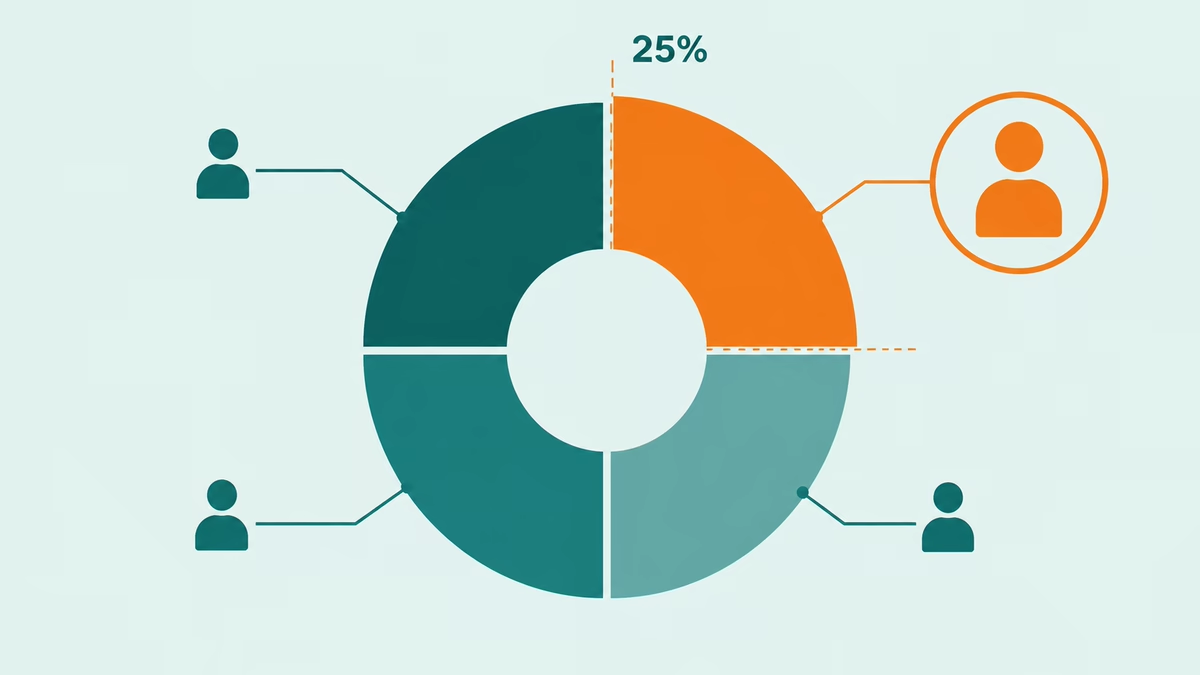
Two of those conditions turn on a 25 percent threshold: holding, even indirectly, 25 percent or more of the voting rights, or shares worth 25 percent or more of the fair market value of all issued shares. The third captures anyone whose influence, if exercised, would amount to control in fact. The last two cover the general partner of a limited partnership and the trustee of a trust.
The obligation has applied since March 31, 2023, introduced by Bill 78. It is the reason your Quebec registration and legal publicity file now asks who is behind the corporate names.
Who has to file, and who is exempt?
Far more businesses than the federal regime. Quebec catches every registrant carrying on business in the province, whatever its home jurisdiction, including sole proprietorships, partnerships and commercial trusts. Ottawa's register applies only to private corporations created under the Canada Business Corporations Act.
| Must declare in Quebec | Exempt in Quebec |
|---|---|
| For-profit corporations and cooperatives | Non-profit legal persons |
| Sole proprietorships | Public-law legal persons |
| General and limited partnerships | Reporting issuers under the Securities Act |
| Trusts operating a commercial enterprise | Banks, insurers, trust companies |
| Quebec, Canadian or foreign registrants | Associations under the Civil Code of Québec |
The most common misreading concerns non-profits. An NPO is genuinely exempt from declaring ultimate beneficiaries, but only from that. It still registers, still declares its directors and their birth dates, and still supplies a government-issued identity document for each director.
Concerted holding is where founders get caught. When several people agree to exercise their voting rights jointly and together reach 25 percent, each of them becomes an ultimate beneficiary, even if none of them clears the threshold alone. A voting arrangement buried in a shareholders' agreement can create reportable individuals nobody expected.
How does Quebec compare with the federal ISC register?
The federal register is narrower in scope and more protective of privacy; Quebec's is broader and genuinely public. Both use the same 25 percent test set out in section 21.1 of the CBCA and the same control-in-fact backstop, but they diverge on who files, what the public sees, and how hard you must look.
| Quebec (REQ) | Federal (CBCA) | |
|---|---|---|
| In force | March 31, 2023 | Register since 2019, public filing since January 22, 2024 |
| Who is covered | All registrants, including sole proprietors, partnerships and trusts | Private CBCA corporations only |
| Is the data public? | Yes, in the public enterprise register | Partly; name, address for service, dates and description of control |
| Birth date public? | No, never | No |
| Search by a person's name? | Yes | No, corporation names only |
| Standard of effort | "Necessary measures" | "Reasonable steps" |
That name-search line is the practical difference most people miss. Since July 31, 2024, anyone can query the Quebec register by an individual's first and last name and see every business that person is tied to. Corporations Canada deliberately refused to allow the same search federally. Our guide to the Quebec enterprise register search walks through how to run that check on yourself.
The effort standard also differs more than it looks. The CBCA asks for reasonable steps once per financial year. Quebec requires "necessary measures", and the Registraire states plainly that this means doing more than what is merely reasonable: a legal, documentary and factual analysis of your ownership structure.
Does a federal corporation in Quebec have to file both?
Yes. This trips up founders constantly. A CBCA corporation carrying on business in Quebec must register with the Registraire des entreprises, and that registration triggers the ultimate beneficiary declaration on its own, entirely separately from the federal obligation to maintain and file an ISC register.
| Obligation | Where it goes | Timing |
|---|---|---|
| Quebec ultimate beneficiaries | Registraire des entreprises | On registration, then within 30 days of a change and at each annual update |
| Federal ISC register | Kept at the corporation's records office | Reviewed at least once each financial year, updated within 15 days |
| Federal ISC filing | Corporations Canada | With the annual return, and within 15 days of a recorded change |
So a federally incorporated company operating in Montréal maintains an internal ISC register, files that information with Corporations Canada, and declares ultimate beneficiaries to Quebec. The definitions overlap heavily, which is good news: one properly documented ownership analysis usually feeds both. Our article on individuals with significant control covers the federal side in detail.
Ontario sits in between. OBCA corporations have had to keep an ISC transparency register since January 1, 2023, but it stays private and is only accessible to tax authorities, police and specified regulators. British Columbia legislated a public registry in 2023 that has still not launched.
What happens if you do not declare?
Quebec fines run from 500 $ to 5,000 $ for a natural person and 1,000 $ to 10,000 $ otherwise, doubled for a director or officer who commits the offence and doubled again on a repeat. The real risk is administrative: after two consecutive years without an update declaration, the Registraire can strike your registration, which dissolves a Quebec corporation.
Federal penalties are heavier on paper. Corporations Canada can pursue a corporation for up to $100,000, while a director, officer or shareholder who knowingly provides false ISC information can face up to $200,000 and two years on summary conviction, or up to $1,000,000 and five years on indictment.
| Failure | Quebec | Federal |
|---|---|---|
| Late or missing declaration | 500 $ to 5,000 $ for an individual, 1,000 $ to 10,000 $ otherwise | Up to $100,000 for the corporation |
| False or misleading information | Same ranges, doubled for a director or officer | Up to $200,000 and 2 years, or $1,000,000 and 5 years on indictment |
| Repeat offence | Amounts doubled | Charged per offence |
| Administrative consequence | Striking of registration, which dissolves a Quebec corporation | Possible dissolution for persistent default |
Quebec adds a civil sanction that is easy to overlook: a non-compliant business can have its right to bring proceedings before the courts suspended. Losing the ability to sue a customer who has not paid you is a much more immediate problem than a fine.

Amounts reflect the statutes in force in August 2026 and the Registraire's fee schedule updated January 1, 2026. Confirm current figures before filing.
What does it cost and when is it due?
Nothing extra. There is no separate ultimate beneficiary form and no dedicated fee. The information rides along with declarations you already file: about 106 $ for a corporation's annual update, about 41 $ for a sole proprietorship, and no charge at all for a current update declaration filed after a change.
The deadline that catches people is the 30-day one. Any change in your ultimate beneficiaries triggers a current update declaration within 30 days, not at your next annual updating declaration. Bringing in an investor, buying back shares or signing a new voting agreement all start that clock.
Frequently asked questions about ultimate beneficiaries
Is an ultimate beneficiary the same as a shareholder?
No. A shareholder holds shares; an ultimate beneficiary is the natural person who actually controls the business. Someone holding 10 percent of shares is usually not an ultimate beneficiary, while a person holding no shares at all can be one through control in fact.
Can a holding company be listed as an ultimate beneficiary?
Generally no, because the law targets natural persons. You must trace the ownership chain up to the individuals behind the holding company. The exception is entities the statute treats as natural persons, such as a legal person acting as trustee.
Do I have to report an exact ownership percentage?
No. Quebec requires a bracket rather than a precise figure: 25 to 50 percent, more than 50 to 75 percent, or more than 75 percent. You report the condition met and the applicable bracket, which limits how much commercial detail becomes public.
Will my home address appear in the public register?
Only if you do not declare a professional address. Where a valid professional address is on file, the register hides the individual's domicile. Birth dates are never publicly viewable, and the details of a minor ultimate beneficiary are fully masked.
Are non-profits really exempt?
Yes, non-profit legal persons are exempt from declaring ultimate beneficiaries under the statutory exemption list. The exemption is narrow though. Every other transparency obligation, including director birth dates and identity documents, still applies to an NPO registered in Quebec.
Get your ownership chain documented properly
Most compliance failures here are not bad faith. They come from a structure that changed quietly: a holding company inserted above the operating company, a family trust added for a freeze, or a voting agreement that pushed two minority holders over 25 percent together.
Lexstart handles your annual update with the Registraire, ultimate beneficiaries included, and reviews the ownership chain behind it. Holding structure, trust or voting agreement to untangle? Get in touch and a lawyer will look at your file.

Stay informed
Get our latest resources and guides for entrepreneurs delivered straight to your inbox
Ready to start your business?
Start your entrepreneurial journey with professional legal support.