
Can You Copyright a Business Name in Canada?

"How do I copyright my business name?" is one of the most common questions Canadian founders ask, and it has a blunt answer: you cannot. Copyright does not protect names. What protects a business name is trademark law, a separate regime with its own register, its own costs and its own deadlines.
Can you copyright a business name in Canada?
No. Copyright protects original works, and the Canadian Intellectual Property Office states plainly that short and one-word titles are not protected by copyright. A business name is protected a different way: by registering it as a trademark, and by the reputation you build through actual use in the market.
The confusion is mostly vocabulary. In everyday speech "copyright" has become shorthand for "protect", so the phrase gets applied to names, logos and slogans alike. In Canadian law the two regimes cover different subject matter, arise differently and are enforced through different remedies.
What copyright actually protects
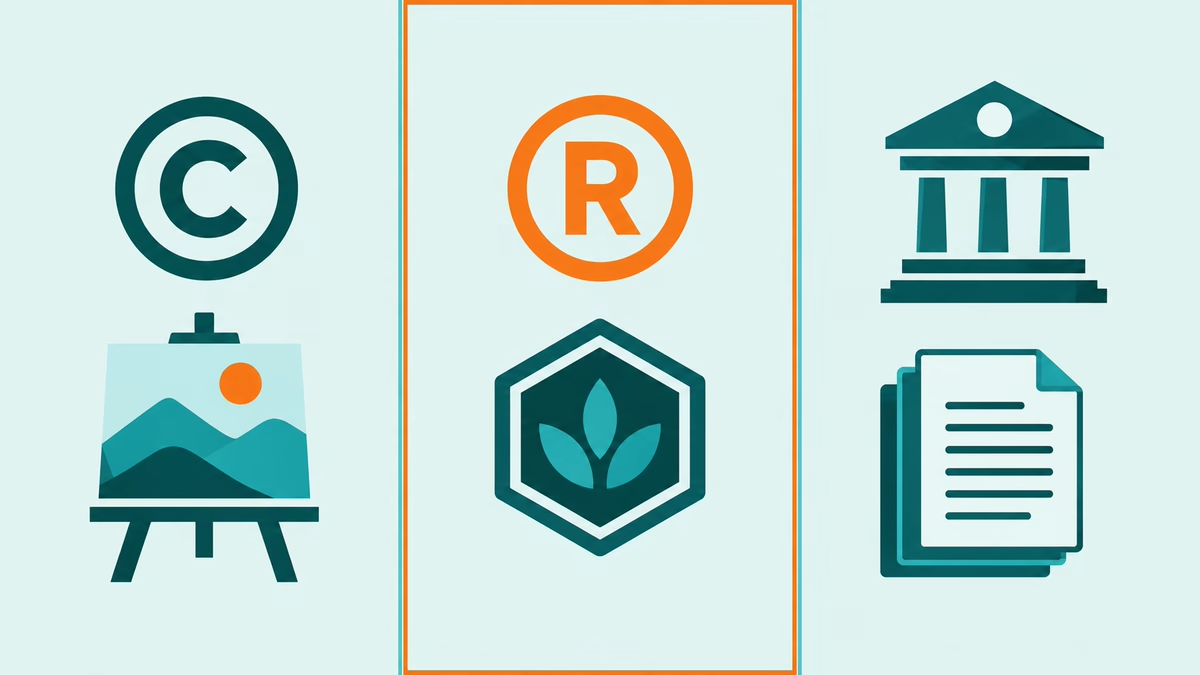
Copyright covers original works: text, illustrations, photographs, drawings. A designed logo qualifies as an artistic work and is protected the moment it is fixed in material form, with no paperwork required. The name written inside that logo falls outside copyright entirely.
Registering a copyright with CIPO is voluntary and costs $63 online. Registration does not create the right, it makes the right easier to prove. The © symbol is equally optional under Canadian law, though some countries still expect it.
This is where the practical split shows up. If a competitor copies your logo pixel for pixel, copyright is the relevant tool. If a competitor opens under a confusingly similar name with a completely different logo, copyright gives you nothing and trademark law is the only route. When you commission a logo, settle the rights in writing in the designer's contract rather than after the fact.
Three registers that do not talk to each other
The costliest assumption in branding is that being recorded somewhere means being protected everywhere. These three registers are independent, and an entry in one produces no effect in the others.
| Quebec enterprise register | Trademarks database (CIPO) | Copyright (CIPO) | |
|---|---|---|---|
| What gets recorded | Corporate name, NEQ | Registered and pending trademarks | Original works, on a voluntary basis |
| What it grants | No right over the name | Exclusive right to use across Canada | Protection of the work, acquired without filing |
| Territory | Quebec | Canada | Canada and treaty countries |
| Cost | Included with registration | $491.06 for the first class | $63, optional |
Quebec's Act respecting the legal publicity of enterprises says it directly in section 19: recording a name in the register confers no right over that name. Your NEQ identifies your business, it does not protect its name.
Search the database before you commit
CIPO's Canadian Trademarks Database holds more than 1.4 million active and inactive marks and can be searched without an account. No search fee appears anywhere in CIPO's fee schedule.
Its limit matters. The database lists only registered and pending marks. A competitor using a similar name without ever filing stays invisible in it, while still being able to challenge your registration if their use came first. A database search is a serious filter, not a guarantee.
Before you print anything, run three separate checks: the enterprise register for the corporate name, the CIPO database for the trademark, and domain availability. Searching only one of the three is how founders discover a conflict after the signage is installed. Our guide on choosing a business name in Quebec covers the naming side in detail.
When you search, look past exact matches. Examiners and opponents consider marks that sound alike, look alike or suggest the same idea for related goods and services, so a name one letter away from an existing registration is not a safe distance.
What registration actually gives you
CIPO acknowledges that filing is not mandatory and that using a mark over time already creates rights at common law. The difference shows up the day somebody challenges you.
| Unregistered mark | Registered mark | |
|---|---|---|
| Source of the right | Actual use in the market | Entry on the federal register |
| Reach | Wherever you can prove reputation | All of Canada |
| Burden in a dispute | You must establish use and reputation | The registration stands as proof |
| Duration | As long as use continues | 10 years, renewable indefinitely |
| Upfront cost | None | From $491.06 |
Section 19 of the Trademarks Act gives the owner of a registered mark the exclusive right to use it throughout Canada for the goods and services covered. That nationwide reach is exactly what local use never delivers on its own.
What it costs to register a trademark
Trademarks are filed by class of goods and services. A company selling clothing and running a restaurant touches two separate classes, so it pays class fees twice.
| Service (CIPO, 2026) | Online | Other means |
|---|---|---|
| Application, first class | $491.06 | $640.10 |
| Each additional class | $149.04 | $149.04 |
| Renewal, first class | $595.06 | $744.10 |
| Renewal, additional class | $185.49 | $185.49 |
| Statement of opposition | $1,115.08 | $1,115.08 |
CIPO has announced a 1.7 percent adjustment on January 1, 2027. The fee that applies is the one in force when the Registrar receives payment, not when you filed, so a class paid next January costs the 2027 rate.
Class selection is where budgets slip. Filing too narrowly leaves competitors room in adjacent categories, while filing across classes you do not actually serve inflates the cost and weakens the application. Map the classes to what you sell today and to what you can realistically launch within three years.
How long it takes, step by step
The official path has five stages: formalities, examination, publication in the Trademarks Journal, the opposition period, then registration. Formalities are confirmed within seven days for an online application. You get six months to answer an examiner's report. The opposition window is two months from advertisement, a deadline set by section 38 of the Act.
On total duration, CIPO publishes two numbers that need to be read together. Its projection for an application filed in September 2026 is roughly 8.1 months, while the office is currently sending applications filed on June 18, 2024 to examination. Its formal service standard is 14 months to a first action. Plan for a year or more, and check CIPO's processing-times page, which is updated continuously.

TM, ® and ©: which symbol you can use
No Canadian law requires a symbol next to a mark. CIPO confirms this. What matters is not claiming a status you do not hold.
| Symbol | Meaning | Registration required |
|---|---|---|
| TM | Trademark | No |
| MC | French equivalent of TM | No |
| ® | Registered trademark | Yes |
| MD | French equivalent of ® | Yes |
| © | Copyright in a work | No, registration is optional |
You can put TM beside your name today without having filed anything. Using ® or MD without a registration is misleading and can be held against you.
Quebec: what changed for signage on June 1, 2025
A trademark in a language other than French can appear as-is on signage, provided no corresponding French version sits on the federal register. The exception covers both registered marks, under section 58.1 of the Charter of the French language, and recognized marks, under section 25.1 of the Regulation respecting the language of commerce and business.
What changed on June 1, 2025 concerns signage visible from outside premises: French must be markedly predominant there, meaning it occupies at least twice the space of the other language with at least equivalent legibility. One counterintuitive consequence: if a French version of your mark is registered with CIPO, that French version is the one that must be displayed.
Frequently asked questions
Can I register my corporate name as a trademark?
Yes, on one condition: the name must distinguish your goods or services, not merely identify the legal entity. A corporation selling under a different banner is not using its corporate name as a mark, and the banner is what should be filed instead.
Does my NEQ protect my business name?
No. Section 19 of the Act respecting the legal publicity of enterprises provides that recording a name in the register confers no right over it. The register exists for legal publicity and identification. Name protection comes only through trademark law.
How long does a Canadian trademark last?
Ten years from the registration date, renewable in ten-year periods with no limit. If the renewal fee is not paid within the prescribed time after the Registrar sends notice, the registration is expunged from the register. A properly maintained mark can therefore last indefinitely, which is why some Canadian brands hold registrations dating back decades.
Is a logo protected by copyright or by trademark?
Both regimes can apply at once and do not exclude each other. The drawing, as an original artistic work, falls under copyright from the moment it is created. That same logo can be filed as a trademark, since the Act includes designs among registrable signs.
Do I need a lawyer to file a trademark?
Nothing requires one for a Canadian application. The hard part is not the form, it is choosing classes, describing goods and services, and assessing the grounds for refusal set out in section 12 of the Act. A poorly built application is paid for in delays.
Protect the name before you build on it
A name is chosen once and defended for years. Check its availability across all three registers before investing in a brand identity, then file it if your business depends on it. Our team can help with trademark filing and with incorporating your business.
Amounts and timelines come from CIPO pages consulted in September 2026 and are subject to change. See CIPO's fee schedule and copyright guide. This article is general information and not legal advice.

Stay informed
Get our latest resources and guides for entrepreneurs delivered straight to your inbox
Ready to start your business?
Start your entrepreneurial journey with professional legal support.