
Employee vs Independent Contractor in Canada: How the CRA Decides

Calling someone a contractor does not make them one. In Canada, the Canada Revenue Agency (CRA) and the courts look at how the work is actually done, and a worker you pay by invoice can still be your employee in law. Getting it wrong leaves the business owing payroll contributions it never collected.
What is the difference between an employee and an independent contractor in Canada?
An employee works under a contract of service: the employer controls how, when and where the work is done and pays a salary with source deductions. An independent contractor works under a contract for services: they run their own business, choose their methods, bear financial risk and invoice a price for a result.
The vocabulary is confusing because the two terms sound almost identical. A contract of service is an employment relationship. A contract for services is a business relationship between a client and a self-employed person. The CRA uses these exact terms in its guide, and they matter more than the job title printed on an invoice.
Self-employed person, freelancer, consultant and independent contractor usually describe the same status for tax purposes. What changes everything is which side of the line the relationship falls on.
| Question | Employee | Independent contractor |
|---|---|---|
| Type of contract | Contract of service | Contract for services |
| Who controls the work | The employer directs what, when and how | The worker chooses methods and schedule |
| How they are paid | Salary or wages, with source deductions | Invoice, no deductions |
| Tools and equipment | Usually supplied by the employer | Supplied and paid for by the worker |
| Financial risk | None, predictable pay | Can make a profit or take a loss |
| CPP or QPP contributions | Split with the employer | Worker pays both halves |
| Employment standards | Covered by provincial law | Generally not covered |
How does the CRA decide if a worker is an employee or self-employed?
Outside Quebec, the CRA asks one key question: is the person providing services as someone in business on their own account, or as an employee? It answers with a two-step approach. First, it looks at what the parties intended. Then it checks whether the facts of the working relationship actually match that intention.
Step one relies on the written contract, the parties' testimony and their conduct. Step two tests the relationship against a set of factors, looked at separately and then together:
- the level of control the payer has over the worker's activities;
- who provides the tools and equipment;
- whether the worker can subcontract or hire assistants;
- the financial risk the worker takes on;
- the worker's responsibility for investment and management;
- the worker's opportunity for profit.
| Factor | Points to an employee | Points to a contractor |
|---|---|---|
| Control | Payer decides what jobs to do, trains and directs the worker | Works independently, free to accept or refuse work |
| Tools and equipment | Payer supplies most tools and pays repairs and insurance | Worker provides tools, pays their upkeep and keeps control of them |
| Subcontracting | Must do the work personally | Can hire helpers or send a substitute |
| Financial risk | No operating expenses, costs reimbursed | Pays fixed costs even between jobs, liable if the work is not delivered |
| Investment and management | No capital investment, no business presence | Capital invested, business presence, manages helpers |
| Opportunity for profit | Pay may vary with commissions, but no profit or loss | Controls revenue and expenses, can profit or lose |
Control is about the right to control, not whether the payer uses it every day. The CRA notes that professionals such as engineers or IT consultants may receive little day-to-day direction and still be employees. No single factor decides, though. The CRA points out that many auto mechanics supply their own tools while working as full-time employees. And controlling the end result of a service you bought is a different thing: a client can set deadlines and specifications without directing how the work gets done.
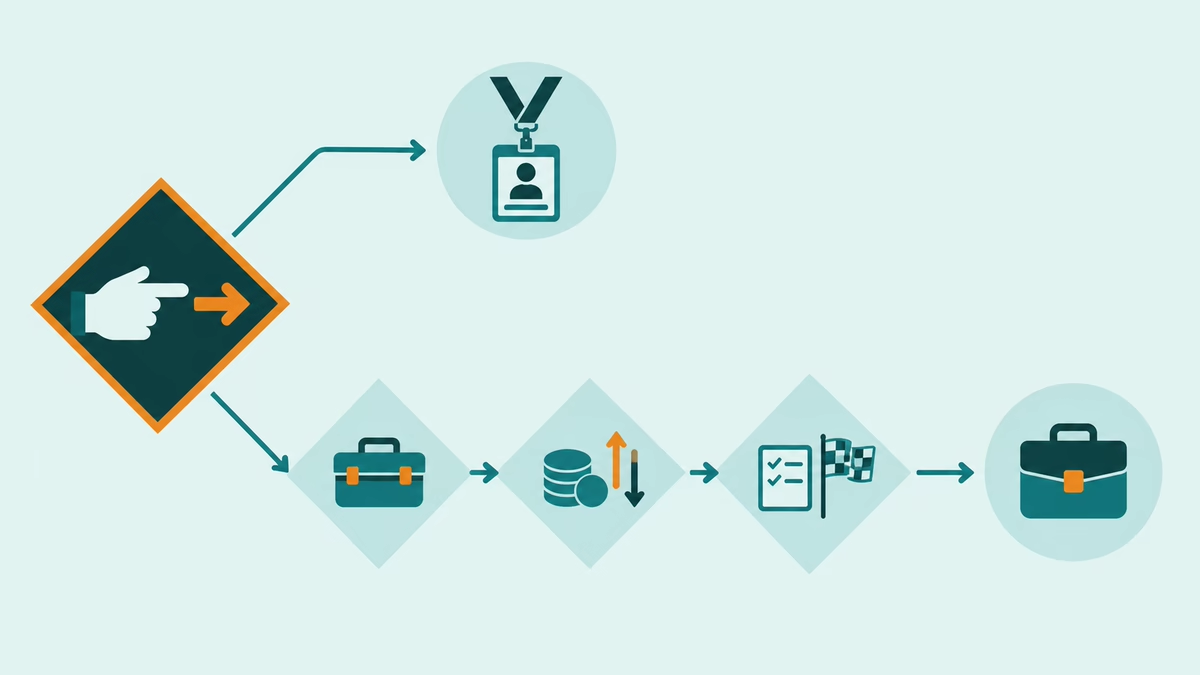
Does Quebec use a different test?
Yes. For contracts formed in Quebec, the CRA applies the Civil Code of Québec instead of the common law test, using a three-step approach. It establishes the parties' intent, checks the relationship against the Civil Code definitions, then compares the stated intent with how the work is really done. The deciding element is the relationship of subordination.
Article 2085 of the Civil Code defines a contract of employment as one where the employee undertakes "to do work under the direction or control of another person, the employer." Article 2099 says a provider of services "is free to choose the means of performing the contract" and that no relationship of subordination exists with the client. The CRA looks at three elements: carrying out the work, remuneration and subordination.
Some of the Quebec employee indicators the CRA lists are easy to trip over:
- the worker's activities are reserved to a single payer;
- the worker must submit activity reports;
- the worker must do the work personally;
- the payer can impose disciplinary measures;
- the written contract contains a non-competition clause.
That last one is easy to miss. A non-compete clause in Quebec is common in employment contracts, and the CRA reads it as a sign of an employment relationship rather than an independent one.
Revenu Québec runs its own analysis for provincial programs and names six criteria: effective subordination, financial risk, ownership of tools, integration of the work into the business, an obligation to deliver a result, and whether the parties actually behave according to their agreement. It treats subordination as the most important. When subordination is clearly present, the worker is an employee without looking any further.
Quebec's Act respecting labour standards goes a step further. Its definition of an employee also covers a worker who does specified work within the framework and methods set by the other party, supplies equipment or goods chosen by that party, and keeps as pay whatever remains after expenses. Depending on the facts, a delivery driver paid by volume can fall inside that definition.
Does a written contract settle the question?
No. A written independent contractor agreement is evidence of intent, but the facts of the relationship decide the status. The CRA says the status the parties choose must reflect the working relationship, and Revenu Québec says two parties agreeing to call someone self-employed is not enough for it to recognize that status.
That is why the classic scenario is so risky: an employee resigns on Friday and comes back on Monday "on contract," at the same desk, doing the same job for the same manager. The paperwork changed; the relationship did not.
A contract still matters. It shows what the parties intended, and when the facts are balanced, a clear agreement that matches reality can tip the analysis. The problem is only when the contract says one thing and daily practice says another.
What does misclassification cost an employer?
If the CRA reclassifies a contractor as an employee, the employer has to pay both its own share and the employee's share of Canada Pension Plan contributions and Employment Insurance premiums that were not deducted, plus penalties and interest. In Quebec, Revenu Québec can also require the employer to pay the provincial contributions that should have been remitted.

The gap is large because of pensions. Canada.ca explains CPP contributions simply: an employee pays half and the employer pays the other half, while a self-employed person makes the whole contribution. Quebec's pension plan works the same way. According to Retraite Québec, an employee contributes 5.3% to the base plan and 1% to the additional plan in 2026, the employer matches it, and a self-employed worker pays both shares at 12.6%, up to maximum pensionable earnings of $74,600.
Figures from Retraite Québec's 2026 contribution examples, checked on September 22, 2026. Rates change every year. Rounded amounts, QPP only.
| 2026 employment income (Quebec) | Employee's QPP contribution | Employer's matching share | Self-employed QPP contribution |
|---|---|---|---|
| $30,000 | about $1,670 | about $1,670 | about $3,339 |
| $50,000 | about $2,930 | about $2,930 | about $5,859 |
| $74,600 | about $4,479 | about $4,479 | about $8,959 |
| $85,000 and over | about $4,895 | about $4,895 | about $9,791 |
Pensions are only one line. An employer also owes EI premiums and, in Quebec, Quebec Parental Insurance Plan premiums, and it must respect provincial employment standards such as vacation pay, statutory holidays and notice of termination. Each unpaid year adds up, so a relationship misclassified for several years can produce a sizable assessment.
Warning signs worth reviewing now:
- one client for years, with a fixed monthly payment;
- a set schedule, a company email address and a spot on the org chart;
- a laptop, phone and software licences supplied by the business;
- no right to refuse work or send someone else;
- a former employee doing the same job "on contract."
How do you get an official ruling on worker status?
Either the worker or the payer can ask the CRA for a CPP/EI ruling through My Business Account, My Account, an authorized representative, or Form CPT1. The request must be made by June 29 of the year after the year in question. In Quebec, QPP and QPIP status decisions come from Revenu Québec using Form RR-65.
The CRA's RC4110 guide on employee or self-employed status sets out the factors and the ruling process. A ruling covers a specific period of work and becomes final unless it is appealed. If the terms of the work change afterward, you can ask for a new ruling.
| Program | Who rules | How to ask | Who can ask |
|---|---|---|---|
| Employment Insurance | CRA | My Business Account, My Account or Form CPT1 | The payer or the worker |
| Canada Pension Plan (outside Quebec) | CRA | My Business Account, My Account or Form CPT1 | The payer or the worker |
| Quebec Pension Plan | Revenu Québec | Form RR-65 | Anyone seeking a decision on their contributions |
| Quebec Parental Insurance Plan | Revenu Québec | Forms RR-65 and RR-65.A | The employer or the worker, when they disagree |
For example, a question about work performed in 2026 has to reach the CRA by June 29, 2027. If June 29 falls on a weekend, the next business day counts.
Can someone be an employee and a contractor at the same time?
Yes. Status is assessed relationship by relationship, not person by person. A nurse can be a hospital employee during the day and run a consulting practice on the side. Each relationship is judged on its own facts, and each stream of income follows its own tax rules, deductions and contributions.
The employment income arrives on a T4, with tax and contributions already deducted. The business income is reported as self-employment income, with its own expenses and both halves of the pension contribution. If taxable sales from the side business pass the $30,000 small supplier threshold, registering for sales taxes becomes mandatory; our guide to GST and QST registration in Quebec walks through the steps.

Be careful when the "side work" is for your own employer. Extra projects that look like your regular job, done under the same authority, can be treated as employment rather than a separate business.
How should you structure an independent contractor agreement?
A solid contractor agreement describes a result to deliver, a price and real freedom in how the work is done. It cannot turn a job into a business relationship, but it documents a genuinely independent one and reduces ambiguity if the CRA or Revenu Québec ever asks questions.
Clauses to check before signing:
- Scope: a deliverable or measurable result, not weekly availability.
- Price: fixed fee, hourly rate or milestones, invoiced by the contractor with sales tax if registered.
- Means of performance: the contractor chooses methods, tools and hours.
- Substitution: the contractor can use helpers or a replacement, subject to confidentiality.
- Non-exclusivity: the contractor stays free to serve other clients.
- Insurance and liability: the contractor carries their own coverage.
- Termination: clear exit terms that fit the province's rules.
A service contract template built for Quebec and Canadian businesses gives you a structured starting point for a genuine freelancer. If your analysis points toward employment instead, it is safer to acknowledge it and use an employment contract template from day one.
On the worker's side, the next question often comes quickly: stay a sole proprietor or incorporate? Our comparison of sole proprietorship vs incorporation in Canada covers taxes, costs and when a corporation starts to pay off.
FAQ about employee vs independent contractor status
Is it better to be an employee or an independent contractor?
It depends on what you value. Employees get predictable pay, employment standards protection, EI and an employer who pays half of their pension contributions. Contractors choose their clients and rates and deduct business expenses, but they carry their own risk, pay both halves of CPP or QPP and have no pay between contracts.
Is self-employed the same as an independent contractor?
For tax purposes, generally yes. The CRA uses "self-employed individual" for someone in business on their own account, and an independent contractor is one example. Freelancers, consultants and sole proprietors can all be self-employed. What matters is the working relationship, not the label someone puts on their business card.
What are the CRA guidelines for independent contractors?
The CRA's RC4110 guide explains them. Outside Quebec, it looks at intent, then control, tools, subcontracting, financial risk, investment and opportunity for profit. In Quebec, it applies the Civil Code and focuses on subordination. A formal ruling can be requested through My Business Account, My Account or Form CPT1.
Can an independent contractor work for only one client?
It is possible, but it is a red flag. Working exclusively for one payer is one of the CRA's Quebec employee indicators, and Revenu Québec treats income from a single employer as a sign of employment. A contractor with one client should make sure the other factors clearly point to an independent business.
How long do I have to ask the CRA for a ruling?
A CPP/EI ruling request must reach the CRA by June 29 of the year after the year the question relates to. Work done in 2026 means a deadline of June 29, 2027. When June 29 falls on a Saturday or Sunday, a request received or postmarked by the next business day is on time.
Do independent contractors get Employment Insurance?
Not regular benefits. The CRA notes that some self-employed people can qualify for EI special benefits by opting into the program and paying premiums. In Quebec, self-employed workers can also be eligible for Quebec Parental Insurance Plan benefits, which pay maternity, paternity, parental and adoption benefits.
Set up the working relationship properly from day one
The right status is decided before the first invoice, not during an audit. Describe the real relationship, pick the contract that matches it, and revisit it when the work changes. For a borderline case or a team restructuring, talk to our team before anyone signs.

Stay informed
Get our latest resources and guides for entrepreneurs delivered straight to your inbox
Ready to start your business?
Start your entrepreneurial journey with professional legal support.