
Corporation Name in Ontario: Rules and Costs

Choosing a corporation name in Ontario looks like a branding exercise, but it is really a compliance exercise with a branding bonus. The rules live in the Ontario Business Corporations Act and its name regulation, and the Ministry leaves most of the risk on your shoulders. Here is how to name a business in Ontario without creating a problem you will pay to fix later.
What makes a valid Ontario corporation name?
An Ontario corporate name is built from three parts: a distinctive element, a descriptive element, and a legal element. The distinctive element is the part that sets you apart, such as a coined word or an unusual combination. The descriptive element tells the public what you do, such as "Roofing" or "Logistics". The legal element is the corporate ending that signals you are an incorporated business.
Only the legal element is strictly mandated. Distinctiveness is enforced indirectly, through the regulation, which blocks names that are too general, only descriptive of the quality or function of the goods and services, primarily just a personal surname, or primarily just a geographic name used alone. Those names can still be accepted in two situations: the name has been in continuous use for 20 years or more, or it has acquired distinctiveness through use.
| Legal element | Abbreviation | Language |
|---|---|---|
| Limited | Ltd. | English |
| Limitée | Ltée | French |
| Incorporated | Inc. | English or French |
| Incorporée | Inc. | French |
| Corporation | Corp. | English or French |
In practice, that means "Ontario Consulting Inc." is fragile on two counts at once: it leans on a geographic name and on a purely descriptive word, with nothing distinctive carrying it. "Kestrel Ontario Consulting Inc." solves the problem because the coined element does the work. The safest structure is a distinctive word first, a plain descriptive word second, and the legal element last.
One more hard limit: the full name, including spaces and punctuation, cannot exceed 120 characters. That sounds generous until you add a long descriptive element and a bilingual version of the same name in the articles.
Speaking of bilingual, an Ontario corporation can have an English-only name, a French-only name, one combined name, or two equivalent forms used separately, and it may be legally designated by either form. If both forms appear in the articles, they must be separated by a forward slash, and each form needs its own name search report. Founders operating across Ontario and Quebec often take the two-form route so each market sees a name in its own language, but they should budget for two searches rather than one.

How much does it cost to name and incorporate in Ontario?
Incorporating in Ontario costs about $300, and online processing is immediate while filing by mail takes about 15 business days. The naming choices layered on top are what move the total.
| Item | Typical cost | Notes |
|---|---|---|
| Ontario incorporation (government fee) | about $300 | Same fee for a named or numbered corporation |
| Ontario-biased NUANS report | about $13 to $75 | Required for named corporations, valid 90 days |
| Business name (operating name) registration | about $60 | Valid 5 years, renewable |
| Name change by articles of amendment | about $150 | Fee to change the name later |
| Trademark application (CIPO) | about $491 first class | About $149 per additional class |
Ontario government fees shown are those in effect as of April 2026 and can change.
Trademark fees are federal and separate from anything Ontario charges. See the current CIPO trademark fee schedule.
Should you choose a named or a numbered company?
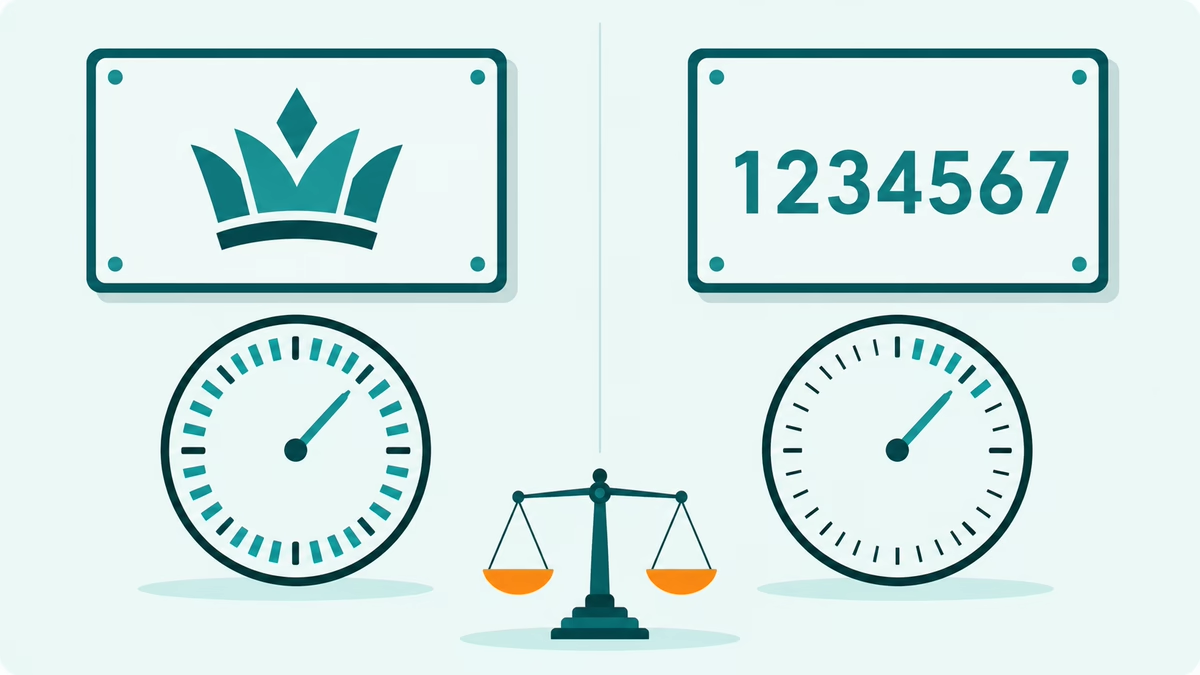
If no name is set out in the articles, the Ministry assigns a number name, for example 1234567 Ontario Inc. The number is assigned at incorporation, so you cannot pick it in advance.
| Factor | Named corporation | Numbered corporation |
|---|---|---|
| Name search report | Ontario-biased NUANS required | Not required |
| Government incorporation fee | about $300 | about $300 |
| Branding value | Carries your brand directly | None on its own |
| Speed to file | Depends on the search first | Immediate, no search step |
| Risk of a name objection | You carry it | Essentially nil |
| Can trade under another name | Yes, with a registered business name | Yes, with a registered business name |
A number name makes sense when you are incorporating a holding company, a real estate vehicle, a joint venture entity, or when you simply need the corporation to exist before the brand is settled. It also removes the whole category of name-conflict risk, which matters if you are moving fast or the brand is still being tested with customers. The trade-off is that you cannot choose or reserve the digits, and a number name carries zero marketing value on a contract, an invoice or a bank form.
The important nuance: a numbered corporation is not condemned to invoice clients as 1234567 Ontario Inc. It can register an operating name and use that publicly, which is often the cleanest split between the legal shell and the consumer-facing brand. Still weighing entity types? Our guide to the most common business structures in Ontario covers the trade-offs.
How do you check if a corporation name is available?
Every named Ontario corporation needs an Ontario-biased NUANS report, valid 90 days. A federal-biased NUANS is not accepted. Buy it from a private search house for roughly $13 to $75; the Ministry does not perform the search. You file the reference number, name searched and report date, and keep the report at the registered office.
Now the part most founders miss. The Ministry does not review proposed names for similarity to other names, and the online system may flag some prohibited words but not all. Acceptance at filing is not approval. Compliance is the incorporators' responsibility, and they carry the risk.
If a corporation acquires a non-compliant name, the Director may, after giving it a chance to be heard in writing, issue a certificate of amendment changing the name. A similar name can also lead to a names hearing or a lawsuit. The Director weighs distinctiveness, how well known the name is, length of use, the nature of the goods and services, the nature of the trade, similarity in appearance and sound, and the geographic area.
Identical names are barred, unless the other body corporate was incorporated outside Ontario and never operated there, 10 years have passed since it dissolved or changed its name, or a lawyer files a legal opinion. Punctuation changes do not make a name different; adding or removing words, numerals or initials, or changing the legal element, does. And a federal corporation with an identical name may not operate in Ontario today but could start any time, so you assume that risk.
Which words are prohibited or restricted in Ontario?
O. Reg. 398/21 splits problem words into two buckets. The first is simply unavailable.
| Prohibited element | Condition |
|---|---|
| Amalgamated | Unless it really results from an amalgamation |
| Association, Co-operative, Council | Barred |
| Digits or wording implying a number name | Barred |
| Veteran | Unless used continuously 20+ years |
| Numerals for the year of incorporation | Barred |
| Link to a political party or its leader | Barred |
| Obscene or scandalous wording | Barred |
| Misdescribing the business or place of origin | Barred |
| Suggesting it is not a business corporation | Barred |
The second needs written consent on file.
| Restricted element | Written consent required from |
|---|---|
| Architect | Ontario Association of Architects |
| Engineer | Association of Professional Engineers of Ontario |
| College, Institute or University implying a post-secondary institution | Minister of Colleges and Universities |
| Condominium | Consent required |
| Link to the Crown, Royal Family, a government or a municipality | The relevant authority |
| Affiliation with a professional association | That association |
| Bank, loan, insurance or trust company, or stock exchange | The relevant regulator |
| A personal surname | The individual, who must also have a material interest |
Does your corporate name protect your brand?
No. Incorporating gives you a corporate name, not trademark rights. That gap is the costliest misunderstanding in Ontario naming.
| Instrument | What it is | What it protects | Cost and term |
|---|---|---|---|
| Corporate name | Legal name in your articles | Identity as a legal entity | about $300, no expiry |
| Operating (business) name | A name you trade under | Nothing exclusive | about $60, valid 5 years |
| Trademark | A registered mark at CIPO | Exclusive rights across Canada | about $491 first class, 10-year renewable |
An Ontario corporation operating under anything other than its corporate name must register a business name. It lasts 5 years, renewable from six months before expiry until 60 days after. Miss that window and you must re-register and get a new BIN. A registered business name gives no exclusivity. Only a trademark gives Canada-wide exclusive rights, so if your name is doing real commercial work, read our guide on how to protect your business with a trademark in Canada first.
FAQ about Ontario corporation names
How to check if a corporation name is available in Canada?
Order an Ontario-biased NUANS report from a private search house for about $13 to $75. It lists similar existing names and stays valid 90 days. The Ministry does not verify similarity, so read the report yourself and assess conflict risk before filing.
What is the difference between a business name and a corporation name?
The corporation name is the legal name in your articles and includes a legal element such as Inc. or Ltd. A business name, or operating name, is any other name you trade under. It must be registered for about $60 and grants no exclusive rights.
How much does it cost to register a business name in Ontario?
Registering a business name costs about $60 and stays valid for five years. You can renew it from six months before expiry up to 60 days after. Miss that window and you must register again from scratch, receiving a new BIN.
Can I rename my business in Ontario?
Yes. You change a corporate name by filing articles of amendment, about $150 in government fees, plus a fresh Ontario-biased NUANS report for the new name. Changing only an operating name means registering a new business name for about $60.
Do I need a NUANS report for a numbered company?
No. If the articles set out no name, the Ministry assigns a number name such as 1234567 Ontario Inc., and no search report is required. The government fee is still about $300, and the corporation can later register an operating name to trade under a brand.
Ready to incorporate in Ontario?
A rushed naming decision can cost you an amendment, a names hearing, or a rebrand. Lexstart handles the search, the compliance review and the filing in one bilingual process. Start your online incorporation, see our pricing, or contact us about a name you already love.

Stay informed
Get our latest resources and guides for entrepreneurs delivered straight to your inbox
Ready to start your business?
Start your entrepreneurial journey with professional legal support.