
Business Bank Account in Canada: 2026 Guide

Opening a business bank account in Canada is usually one of the first jobs after incorporation because the bank must confirm that the corporation exists, identify who can act for it, and understand who ultimately owns or controls it.
A separate account also gives the corporation a clean financial record for tax time, financing, and any dispute over whether a payment belonged to the company or a shareholder, so this guide focuses on corporations with added steps for companies formed or operating in Quebec.
Do you need a separate bank account for your corporation in Canada?
No standalone federal or Quebec rule says every corporation must open a separate bank account. Still, using one is the sound practice. A corporation is a separate legal person, corporate money belongs to it, and tax records must show its transactions. A dedicated account makes that separation visible.
The Canada Revenue Agency's guidance on corporations describes a corporation as a separate legal entity that can own property and enter contracts in its own name. Quebec law reaches the same result. Under the Quebec Business Corporations Act, a corporation becomes a legal person when it is constituted.
That distinction is the reason to separate cash flows. It is not a magic shield. Directors can still face personal liability in specific cases, and a lender may ask for a personal guarantee. But paying groceries from the corporate account or depositing company revenue into a personal account creates evidence that must later be untangled.
QuestionCorporationSole proprietorshipWho owns the money?The corporation owns its funds.The owner and business are the same legal person.Is the business a separate legal person?Yes.No.Is a dedicated account a standalone legal requirement?No rule located imposes one, but separation is strongly advisable.No general rule makes one mandatory, though a bank may require a business account under its terms.What does a separate account improve?Corporate records, tax support, signing control, and proof of ownership.Bookkeeping and tax preparation.
| Question | Corporation | Sole proprietorship |
|---|---|---|
| Who owns the money? | The corporation owns its funds. | The owner and business are the same legal person. |
| Is the business a separate legal person? | Yes. | No. |
| Is a dedicated account a standalone legal requirement? | No rule located imposes one, but separation is strongly advisable. | No general rule makes one mandatory, though a bank may require a business account under its terms. |
| What does a separate account improve? | Corporate records, tax support, signing control, and proof of ownership. | Bookkeeping and tax preparation. |
Collected GST, HST, and QST add another reason for discipline. Tax law treats amounts collected as tax as held in trust until remitted. That rule does not order you to open another account. It does mean those amounts should not be mistaken for spendable shareholder cash.
What is required to open a business bank account in Canada?
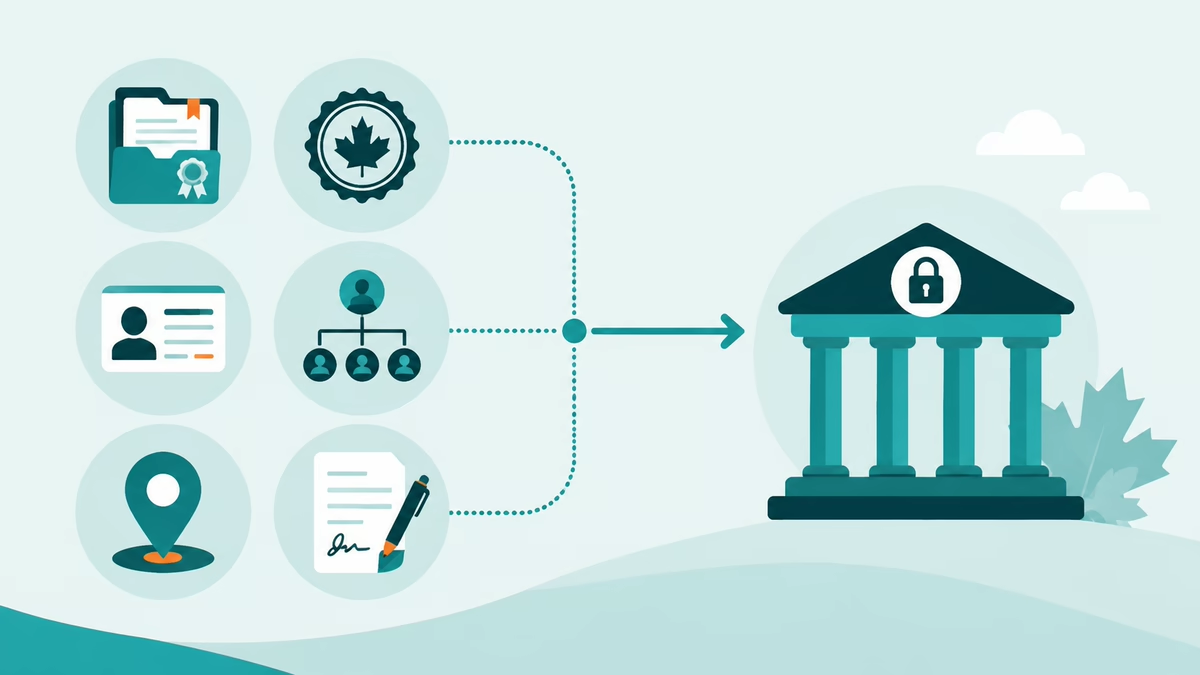
A bank normally needs current proof that the corporation exists, identification for the people acting on its behalf, details about directors and beneficial owners, and authority showing who may sign. The exact checklist varies by institution, account, ownership structure, and whether the application starts online or in person.
FINTRAC sets the identification framework Canadian financial institutions follow. Its corporate identity verification guidance allows a bank to confirm a corporation's name, address, and directors through records such as a certificate of incorporation, current corporate status record, annual filing, or a reliable public registry. The record must be authentic, valid, and current.
Document or informationWhat it helps the bank confirmWhere to lookArticles and certificate of incorporationLegal name, jurisdiction, incorporation date, and existenceYour incorporation packageCurrent corporate profile or registry recordRegistered office, directors, and current statusCorporations Canada or the provincial registryBusiness number and tax account numbersCRA registration and applicable program accountsCRA correspondence or My Business AccountNEQ and Quebec registration detailsRegistration with the Registraire des entreprises du QuébecQuebec enterprise registerShare register and ownership chartShareholders and the path to the individuals who own or control the companyCorporate minute bookGovernment-issued identificationIdentity of directors, signing officers, and other people the bank must verifyEach person concernedBanking resolution or signing authority recordWho the corporation authorizes to open and operate the accountDirectors' resolution or bank form, when requested
| Document or information | What it helps the bank confirm | Where to look |
|---|---|---|
| Articles and certificate of incorporation | Legal name, jurisdiction, incorporation date, and existence | Your incorporation package |
| Current corporate profile or registry record | Registered office, directors, and current status | Corporations Canada or the provincial registry |
| Business number and tax account numbers | CRA registration and applicable program accounts | CRA correspondence or My Business Account |
| NEQ and Quebec registration details | Registration with the Registraire des entreprises du Québec | Quebec enterprise register |
| Share register and ownership chart | Shareholders and the path to the individuals who own or control the company | Corporate minute book |
| Government-issued identification | Identity of directors, signing officers, and other people the bank must verify | Each person concerned |
| Banking resolution or signing authority record | Who the corporation authorizes to open and operate the account | Directors' resolution or bank form, when requested |
Beneficial ownership often causes the most back-and-forth. FINTRAC defines beneficial owners of a corporation as the individuals who directly or indirectly own or control at least 25% of its shares. The institution must look through holding companies to the individuals at the end of the chain. Its beneficial ownership requirements list articles, shareholder registers, minute books, shareholder agreements, and directors' records among the documents that can help confirm the information.
A banking resolution is an internal authorization. It usually records the institution, the approved signing officers, and whether signatures may be given alone or jointly. Banks often provide their own form. There is no single universal resolution that every corporation must adopt under the same wording. Use the institution's instructions and make sure the record matches the corporation's minute book.
Can I open a corporate bank account online?
Many banks let you begin online, but a fully remote opening is not guaranteed. A complex ownership chain, several signing officers, foreign owners, or documents the bank cannot verify may lead to a call or branch visit. Check the institution's process before assuming one online form will finish the job.
The application itself is only one part of the work. Prepare the corporate records first, agree on signing authority, and make sure names and addresses match across the minute book, registry, CRA records, and identification. Small inconsistencies can trigger manual review.
StepWhat to doCommon hold-up1. Choose the accountMatch transaction limits, payment tools, currencies, and deposit methods to actual use.Choosing on monthly fee alone2. Update corporate recordsConfirm directors, registered office, shareholders, and beneficial owners.Registry and minute book do not match3. Set signing authorityDecide who can open, instruct, and close the account.No approved resolution or unclear joint signatures4. Gather identificationFollow the bank's list for each person it must verify.Expired or inconsistent identification5. ApplyComplete the online process or attend the appointment with originals if requested.Complex ownership needs extra review6. Connect bookkeepingSet feeds, expense rules, tax reserves, and access permissions.Personal transactions continue through the new account
| Step | What to do | Common hold-up |
|---|---|---|
| 1. Choose the account | Match transaction limits, payment tools, currencies, and deposit methods to actual use. | Choosing on monthly fee alone |
| 2. Update corporate records | Confirm directors, registered office, shareholders, and beneficial owners. | Registry and minute book do not match |
| 3. Set signing authority | Decide who can open, instruct, and close the account. | No approved resolution or unclear joint signatures |
| 4. Gather identification | Follow the bank's list for each person it must verify. | Expired or inconsistent identification |
| 5. Apply | Complete the online process or attend the appointment with originals if requested. | Complex ownership needs extra review |
| 6. Connect bookkeeping | Set feeds, expense rules, tax reserves, and access permissions. | Personal transactions continue through the new account |
Set account controls while the application details are still fresh. Give each user their own access instead of sharing the main sign-in. Limit payment, transfer, and administrative permissions to the jobs each person performs. If two directors are meant to approve large payments, ask whether the bank can enforce that rule in its online banking system rather than relying on an informal promise.
Decide where tax money will sit, who reviews statements, and how often the account will be reconciled. A second savings account for tax reserves may help with cash management, but it does not replace bookkeeping or change the legal treatment of collected taxes. Record the purpose of every transfer between accounts.
Do not promise staff that the account will be usable on a specific day until the bank confirms it. Approval time depends on the bank's verification process and the corporation's structure. A single-owner company with current records is usually simpler than a company with several entities in its ownership chain.
What does a Quebec corporation need on top of the federal requirements?
A Quebec corporation should have its NEQ and current enterprise register information ready. A federal corporation operating in Quebec may also need Quebec registration. Keep the federal or provincial incorporation records, the Quebec registry record, CRA business number, and QST details aligned before the bank reviews them.
The NEQ identifies the enterprise in the Quebec register. It is not a substitute for the articles or certificate of incorporation. The bank may use several records because each answers a different question. The articles show how the corporation was created, the registry shows current public information, and the minute book records internal ownership and authority.
If you are still choosing a jurisdiction, Lexstart's guide to incorporating in Quebec explains the formation step. If the company has not yet been formed, the online incorporation service creates the corporate package you will later use for banking and other registrations.
What happens if you mix personal and corporate money?
Mixing funds does not automatically erase the corporation. It does make accounting, tax support, shareholder transactions, and control harder to prove. Each personal payment from the company may need to be classified as salary, dividend, reimbursement, shareholder loan, or a corporate expense supported by records.
The CRA requires business records that let it determine taxes payable. Its business record guidance treats bank statements, deposit slips, and cheques as source documents. One account filled with personal and corporate activity forces the bookkeeper to reconstruct the story transaction by transaction.
- Corporate revenue can be missed or counted twice.
- Personal withdrawals may sit in a shareholder loan account until they are classified and resolved.
- Expense claims become harder to support when the payee and purpose are unclear.
- Other directors or shareholders may not be able to see who approved a payment.
- A financing or due diligence review may take longer because the records need cleanup.
Use the corporate account for corporate revenue and expenses. Pay yourself through a documented method chosen with your accountant. Keep receipts attached to transactions, and reconcile the account on a regular schedule. If you already mixed funds, do not hide the transfers. Have the bookkeeper classify them and correct the records.

Which Canadian bank is best for business accounts?
There is no best bank for every corporation. Choose based on transaction volume, payment methods, cash deposits, currencies, user permissions, accounting integration, credit needs, and service access. The cheapest monthly plan can cost more if it charges for the transactions your business makes most often.
CriterionQuestion to askWhy it mattersTransactionsHow many deposits, bill payments, transfers, and cheques are included?Per-transaction charges can outweigh a low monthly fee.Cash and chequesCan the business deposit them nearby and at the times it operates?Online-only options may not fit cash-heavy businesses.PaymentsDoes the account support payroll, tax payments, wires, and vendor approvals?The account must fit daily operations.Access controlsCan you give users different permissions and require two approvals?Controls reduce unauthorized or mistaken payments.CurrencyWill the corporation receive or pay funds outside Canada?Conversion spreads and wire fees can become material.Credit relationshipWill the corporation soon need a card, line of credit, or loan?A broader relationship may matter more than the deposit fee.BookkeepingDoes the bank connect cleanly to the accounting system?Reliable feeds cut manual entry and reconciliation work.
| Criterion | Question to ask | Why it matters |
|---|---|---|
| Transactions | How many deposits, bill payments, transfers, and cheques are included? | Per-transaction charges can outweigh a low monthly fee. |
| Cash and cheques | Can the business deposit them nearby and at the times it operates? | Online-only options may not fit cash-heavy businesses. |
| Payments | Does the account support payroll, tax payments, wires, and vendor approvals? | The account must fit daily operations. |
| Access controls | Can you give users different permissions and require two approvals? | Controls reduce unauthorized or mistaken payments. |
| Currency | Will the corporation receive or pay funds outside Canada? | Conversion spreads and wire fees can become material. |
| Credit relationship | Will the corporation soon need a card, line of credit, or loan? | A broader relationship may matter more than the deposit fee. |
| Bookkeeping | Does the bank connect cleanly to the accounting system? | Reliable feeds cut manual entry and reconciliation work. |
Lexstart clients can receive a $350 refund on Lexstart services when they open a National Bank of Canada account within three months of their order. Review the conditions on the entrepreneur partner offer page before relying on the refund.
Offer, banking terms, and fees checked August 27, 2026. They can change. Confirm current conditions with the institution.
Frequently asked questions about business bank accounts
What is the $10,000 bank rule in Canada?
FINTRAC requires reporting entities to report receiving $10,000 or more in cash in one transaction, or linked cash amounts totalling that threshold within 24 hours. Its large cash transaction guidance explains the rule. It does not mean every ordinary electronic transfer over $10,000 is a large cash transaction.
Can the CRA see your bank account?
The CRA does not get a live view of every business account simply because the account exists. It can require records through lawful audit and information-gathering powers, and financial institutions have separate reporting duties under specific laws. Keep statements and supporting documents as if you may need to explain each material transaction.
Which Canadian banks offer free business bank accounts?
Some institutions advertise no-monthly-fee business accounts, but the label does not mean every transaction is free. Review included transfers, deposits, cash handling, cheque use, currency conversion, and minimum balance conditions. Compare the expected total cost for your real monthly activity rather than the headline fee.
Is it mandatory to have a business account for a sole proprietorship?
A sole proprietorship is not a separate legal person, and no general rule located makes a dedicated account mandatory. Still, separate banking makes tax records easier to follow. Your bank's personal account agreement may also restrict business use, so check its terms before taking customer payments into a personal account.
How long does it take to open a business bank account?
There is no dependable time that applies to every bank and corporation. The process depends on document quality, ownership complexity, signing officers, residency, and the bank's review. Ask for the institution's current estimate after it has seen the structure, and avoid scheduling payroll or closing funds against an unconfirmed date.
What conditions apply when opening a professional bank account for a company?
The bank must be able to identify the corporation, the people acting for it, and its beneficial owners. It may also assess the business activity, expected transactions, jurisdictions, and source of funds. Conditions differ by institution, so request its checklist and treat the FINTRAC requirements as the minimum framework, not a complete product checklist.
Prepare the corporate file before the bank appointment
A clean account opening starts before the appointment. Update the registry, organize the minute book, confirm beneficial owners, and approve signing authority. If your incorporation records are incomplete or the ownership changed, fix those records first. Contact Lexstart for help with the corporate documents, then confirm banking requirements directly with the chosen institution.
This article provides general information, not legal, tax, accounting, or banking advice for a specific corporation.

Stay informed
Get our latest resources and guides for entrepreneurs delivered straight to your inbox
Ready to start your business?
Start your entrepreneurial journey with professional legal support.